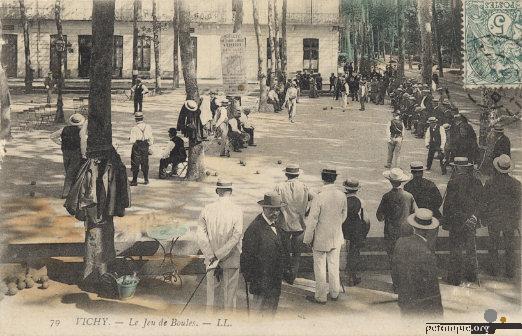
The history of the petanque is not only events, but also a kind of ethos. We have no doubt that this game is associated with a certain philosophy of life and a world of experiences that are pleasant and close to hundreds of thousands of people.
Like any true story, our story must begin according to the ancient poetic tradition: Long, long ago (5 thousand years ago!), right on the coast of the southern sea, in the shade of palm trees and pyramids, amidst the chirping of cicadas, an Egyptian took a ball in his hand… Then there were – as is usual in history lessons – the Greeks. They preferred a power game – the rivalry involved throwing the (stone) balls as far as possible. The Roman legionnaires, contrary to stereotypes, gave the game a more sophisticated and precise character. They used wooden balls, which over time were covered with metal. They also invented the “swinger”.
During the period of barbarian invasions, the “ball game” disappeared (which suggests that it is a pastime for noble minds;)). It declined in the Middle Ages and gained such popularity that in the 14th century its practice was banned. The kings of France recognized that the population under their control should engage in something more useful. The popes came to the aid of the proponents of “ball.” In the 16th century, Pope Julius II, desiring the return of the apostolic capital to Italy, gathered the best players into a team that was to be undefeated in throwing stones.
In the 17th century, the proponents of throwing balls again fell into disgrace. The opponents of the game caused it to be banned again. Despite this, “adherents” met in secret to cultivate the tradition. Very often it was played in monasteries. It was the monks who built the first (covered!) “bulodromy”. Fortunately, the ban on the game was lifted after a few years. The popularity of the game grew in both countries. Rabelais said: “Neither rheumatism nor other diseases are capable of stopping anyone from playing this game. It is suitable for people of all ages, young and old.”.
The Renaissance game is revived in the 19th century. It is then that the rules of the Jeu de Provencal are created – from the perspective of modern players in petanque Very complicated. In 1910, a group of players practicing Jeu de Provencal decided to simplify these rules in order to make the game more common. First of all, the distance of throws was shortened and the draw was eliminated; the scoring system was also simplified. This resulted in a discipline called petanque. The etymology of the name of the game derives from the Provençal words ped tanco, (fr. pieds tanqués), which mean “feet together”. The ease of playing made the petanque craze grow rapidly and spread beyond Provence – first to Switzerland and Belgium, then to Canada and Australia. Today, it is difficult to find a country where this discipline is not played.
In 1959, the first World Championships were held in Spa, Belgium. Currently, efforts are underway to make the game of “bullfighting” an Olympic discipline.
